

Imagine the following scenario: You are asleep when your phone starts displaying alarming messages about a wildfire coming towards you. Your heart sinks as you gather your family and belongings, only to realize hours later that the fire was miles behind you in another direction.
Frustrating, right?
This situation clearly reveals why sensor accuracy is not just a technical issue; it is a matter of life and death.
What’s Really at Stake?
The modern world is a global village, and we live in an era with advanced sensor networks that can alert us to disasters such as extreme weather and industrial accidents. However, these systems are only as good as the data they gather.
Your tornado warning makes you jump at the sound of your phone, or an evacuation order comes through, and you make split-second decisions based on that information. Will you wake up your kids? Leave work early? Take shelter immediately?
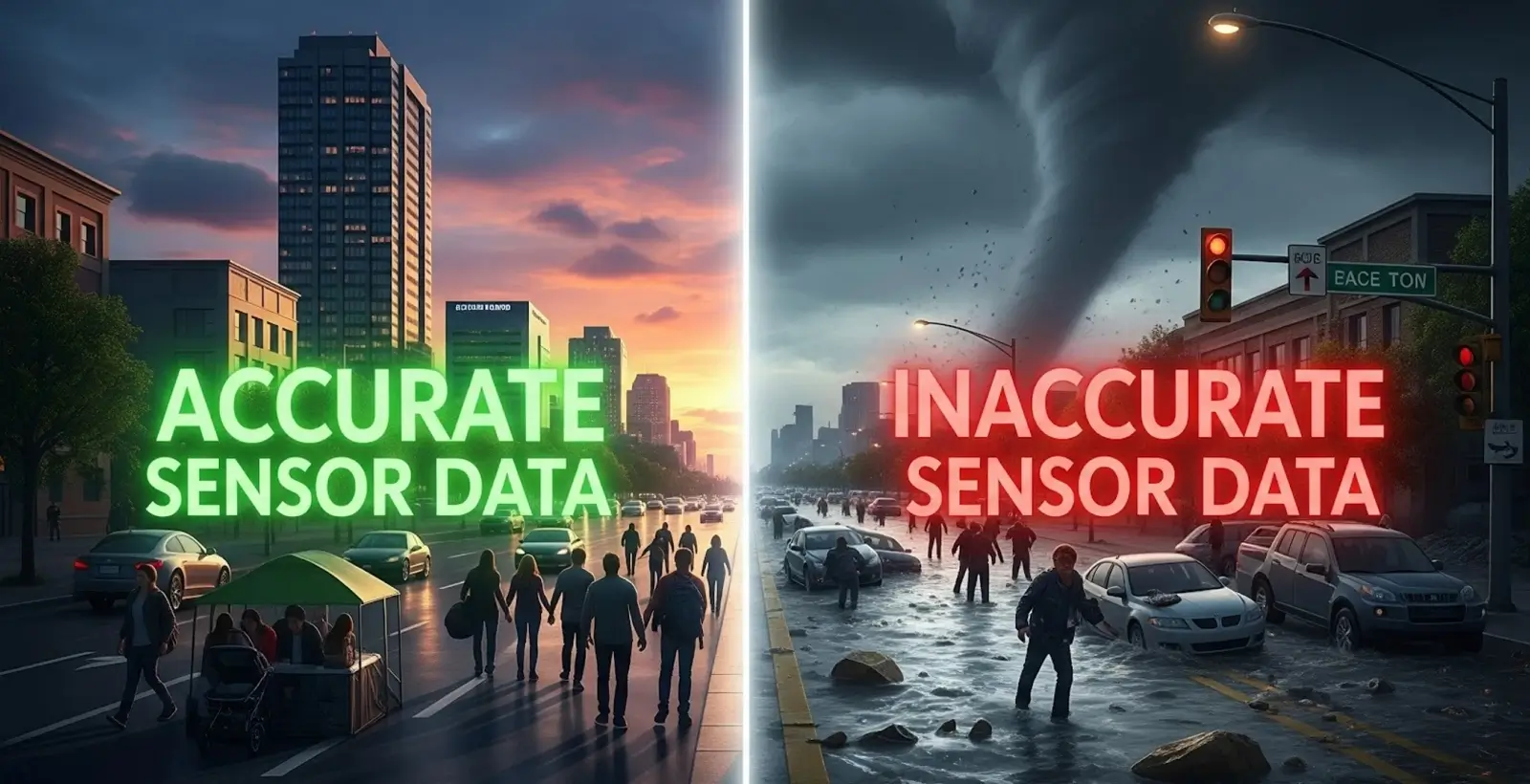
These aren’t trivial choices. All of them are based on one important premise: the quality of the data used to generate these alerts.
The Trust Factor
Sensor accuracy directly influences public trust in emergency systems. As soon as notifications turn out to be false or deceiving, individuals begin to disregard them. It is the old “boy who cried wolf” story, only with life-or-death stakes.
When sensors provide reliable data, emergency services can issue warnings confidently, and people react appropriately.
When Things Go Wrong
The consequences of defective sensors are far greater than mere inconvenience. Let’s look at a few real-world examples:
- Seismic sensors: An inappropriate seismic sensor may fail to detect the strength of an earthquake promptly enough to issue warnings before a large-scale event. Conversely, hypersensitive equipment might trigger more evacuations than necessary, draining resources and destroying trust in authorities.
- Weather monitoring: Temperature and humidity gauges that lose calibration may falsely indicate weather conditions that could lead to serious floods or heat waves. Even a couple of degrees of deviation during severe weather can be the difference between a disaster and a timely alert.
This is something organizations involved in disaster relief in Australia are well aware of. Through proper early warnings, they can position resources in advance and coordinate faster responses, ultimately saving more lives during a disaster.
What Makes Sensors Tick?
Contemporary public safety systems are based on a variety of sensors:
- Seismometers sense movement in the ground.
- Air quality monitors measure pollution levels.
- Precipitation is measured using radar systems.
- Atmospheric conditions are recorded at weather stations.
All of these have different calibration needs and possible failure points.
The Accuracy Challenge
Sensor accuracy is continuously tested by environmental factors. Physical wear, temperature variations, dust, and humidity all adversely affect performance over time.
There is a marked difference in the reading of a weather sensor covered with ice compared to a clear one. When chemical sensors are exposed to contaminants, they could drift far from their baseline.
This is why maintenance, calibration, and replacement schedules cannot be considered luxuries to be cut from constrained budgets.
The People Behind the Technology

Here is something people frequently fail to notice: sensors do not work in a vacuum. Human interpretation of sensor data is behind all alerts.
Emergency managers need to analyze data and decide whether to alarm or not. Accurate sensors make their jobs significantly easier since they can trust the clean and reliable data.
The technical skills needed to service these systems are extensive. Professionals must have comprehensive knowledge of the instruments and phenomena they are testing. You need specialized instrumentation courses to train technicians to fit complex equipment, calibrate it, and fix it when it breaks; this expertise forms the basis of our safety infrastructure.
Yet, even perfect sensors cannot account for the human factor in installation or interpretation. A flood gauge set in the wrong location reports the correct levels of the wrong area. Air quality sensors located close to exhaust vents do not reflect normal conditions.
The Real Cost of Inaccuracy
Let’s talk about the bottom line. False alarms are not only irritating; they are costly.
When a city is evacuated needlessly:
- Businesses lose revenue.
- Emergency services squander resources.
- There is a strain on public infrastructure.
Multiply this by numerous false alarms, and the expenses are incredible.
On the other hand, faulty sensors may result in missed warnings, which can be disastrously expensive. Damage to property, injuries, and loss of life have massive economic costs on top of the incalculable human cost.
Social Consequences
The social impacts of sensor malfunctions on communities are also significant:
- False alarms cause anxiety and a lack of trust in the system.
- Overlooked alarms destroy confidence in government institutions.
- When alert systems fail, vulnerable groups—such as the elderly, the disabled, or those with language barriers—are disproportionately affected.
Sensor accuracy is, therefore, a matter of equity, influencing how various community segments are safeguarded by public safety resources.
Why This Matters to You
The moral of the story is that correct sensors save lives.
They enable:
- Timely warnings.
- Successful emergency responses.
- Public confidence in safety systems.
The need to improve sensor accuracy continues to increase as populations become more susceptible to threats like climate change, industrial accidents, and natural disasters.
Investment in sensor technology, maintenance, and expertise involves more than just purchasing superior gadgets. It is about developing resilient communities where individuals can trust the notifications they receive and act decisively during an emergency.
The next time you get a notification on your phone about a weather alert, remember that an advanced network of well-tuned sensors is working unnoticed to keep you safe.